
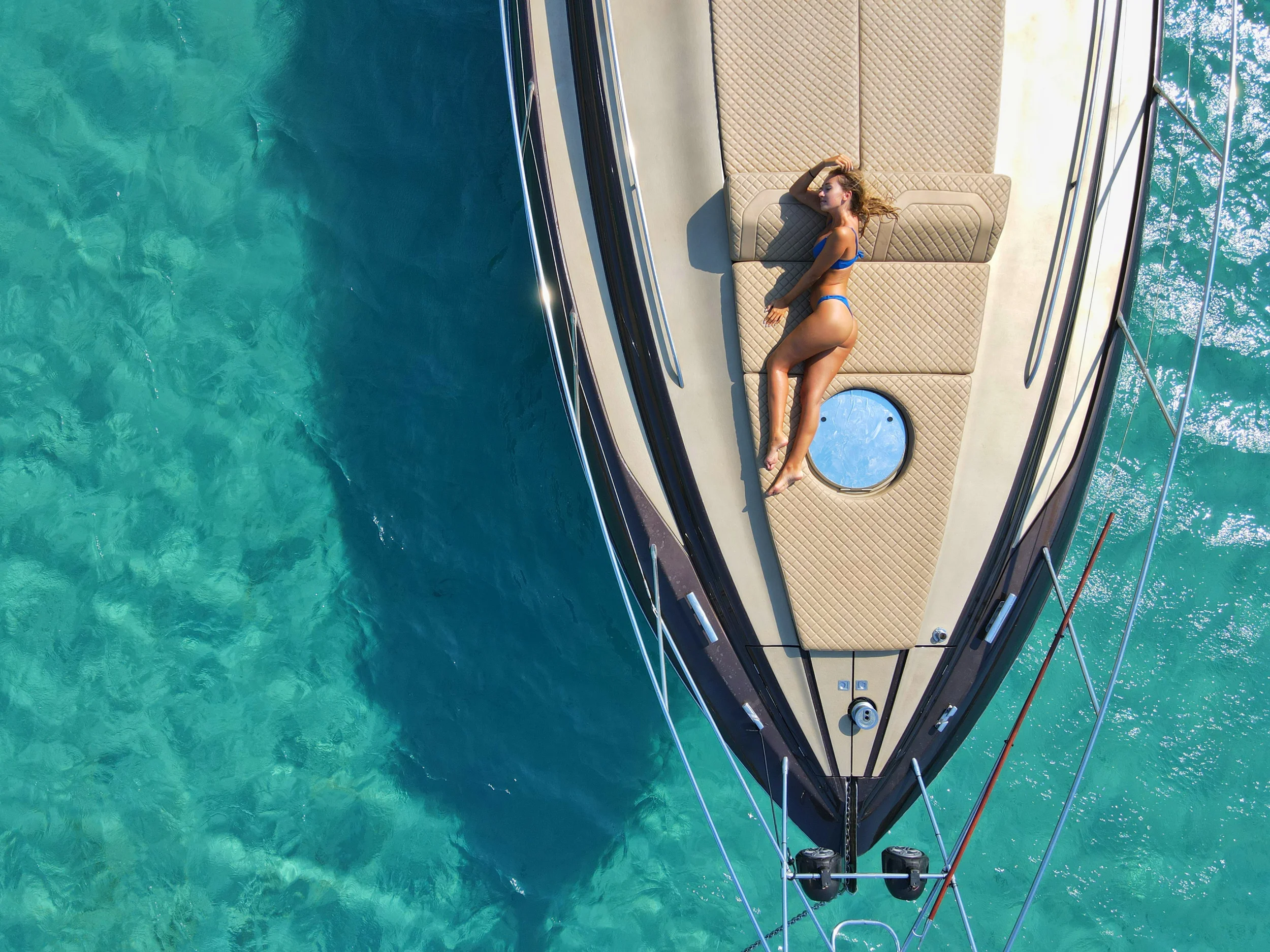

Most guests choose a destination first and a boat second, which is the wrong way round more often than not. The hull decides how the week feels: how much it moves at anchor, how far you get in a day, and how much space ten people actually have.
Groups spend a long time deciding between Croatia and Greece and almost no time deciding what they want to be standing on. That is backwards. The destination sets the scenery. The hull sets almost everything else about the week: how much the boat moves when you are trying to sleep, how many bays you see in a day, whether ten people can eat together without rearranging furniture.
There are three answers in practice, plus a fourth that comes up often enough to be worth explaining. This is how to pick between them.
The short version
| Catamaran | Sailing monohull | Motor yacht | |
|---|---|---|---|
| Movement at anchor | Least | Most | Middle |
| Deck and living space | Most for the length | Least | Generous, spread over decks |
| Bays covered per day | Fewer | Fewer | More |
| Cabins for the length | Usually more | Usually fewer | Varies widely |
| Suits | Families, mixed groups, anyone prone to seasickness | Guests who want to sail | Groups covering distance, or wanting a hotel that moves |
Catamarans
A catamaran sits on two hulls, and everything else follows from that. It barely rolls at anchor and it stays flat under sail rather than heeling. If anyone in the group is anxious about seasickness, worried about small children moving around, or simply does not fancy sleeping on a boat that leans, this is the answer and the decision is not close. Our guide to seasickness on a charter covers the cruising grounds and crew decisions that matter alongside the hull.
The second advantage is space. A 16-metre catamaran has a wider beam than a 20-metre monohull, which means a bigger saloon, a proper cockpit table and a deck you can spread out on. Cabins sit in the hulls, one to each side, so couples get genuine separation rather than a corridor of berths.
The trade-off is pace and feel. A cruising catamaran under sail is comfortable rather than thrilling, and it will not point as close to the wind as a monohull. Most of our Greek fleet is catamarans for exactly the reasons above, and the Athens boats are a good illustration of the type: 16 to 20 metres, six to twelve guests, five or six cabins.
Sailing monohulls
One hull, deeper draft, and the boat heels when the wind fills the sails. For some guests that is the entire point, and no amount of deck space compensates for losing it. A monohull moves through the water in a way a catamaran does not, and if you have sailed before you already know whether this matters to you.
Practically: less interior volume for the same length, fewer cabins, and real movement at anchor in an exposed bay. In exchange you get better upwind performance and, at the same length, usually a lower rate than the equivalent catamaran.
This is the choice for guests who want to be sailing rather than being transported. On a crewed yacht you can take the helm as much as the captain is happy to allow, which on most boats is a great deal more than people expect.
Motor yachts
No sails, so no dependence on wind direction, and considerably more speed. A motor yacht turns a three-hour passage into an hour, which changes what a week covers. If your group wants to see Hvar, Vis and Korčula properly rather than choosing two of them, this is how that happens.
They are also the most hotel-like of the three: multiple decks, air conditioning that runs without argument, and interiors closer to a villa than a boat. Larger motor yachts carry more crew, and the difference between two crew and four is not subtle. Two crew handle the basics. Four means someone is looking after the cabins, the tender and the drinks while the captain is driving.
Motor yachts make up the larger part of our fleet overall, and they run to the biggest boats we list. The Split fleet is where the largest of them sit, up to 55 metres and 26 guests.
The trade-off is fuel, which is paid from the provisioning fund the captain manages rather than the headline rate. A week of long passages costs meaningfully more to run than a week of short ones. Our guide to what's included in a crewed charter sets out how that side of a quote works.
Gulets
A gulet is a wooden motor sailer, traditionally built, wide and heavy, with a lot of shaded deck and cabins below. They carry large groups comfortably and they are unhurried by design. Nobody charters a gulet to go fast.
They come up most often for extended families and groups of friends travelling together who want everyone on one boat and a lot of communal space. If that is your group, ask about them specifically.
How to actually choose
Work through it in this order, because each answer narrows the next.
- How many people, and in what pairings? Cabin count matters more than length. Four couples need four proper cabins, and that rules out a lot of otherwise suitable boats.
- Is anyone worried about movement? If yes, catamaran. This overrides most other preferences, because a guest who feels ill on day one has a ruined week.
- Do you want to sail, or to arrive? Monohull for the first, motor yacht for the second, catamaran for a compromise that leans towards comfort.
- How much ground do you want to cover? Long itineraries favour a motor yacht. A week in one archipelago does not need one.
- Then filter by dates and budget, not before. The rate follows the boat, and comparing a 16-metre catamaran against a 30-metre motor yacht on price alone tells you nothing useful.
Every yacht we list is crewed or skippered, so none of this depends on anyone in your group holding a licence. If the crewed, skippered and bareboat formats are still unclear, crewed vs bareboat vs skippered explains how they differ and which of them we list.
Where to start
Filter the fleet by guest capacity first and hull type second at browse yachts, or look at what is based in a particular port from the destinations page. Each listing shows its length, guest capacity, cabin count, crew and current rate, which is enough to compare two boats honestly.
When you have two or three that fit, send an enquiry with your dates and party size. The request goes to the owner or manager, who confirms what is genuinely available for your week and puts you in direct contact. After that is settled, how to charter a yacht walks through the rest of the process in order.