
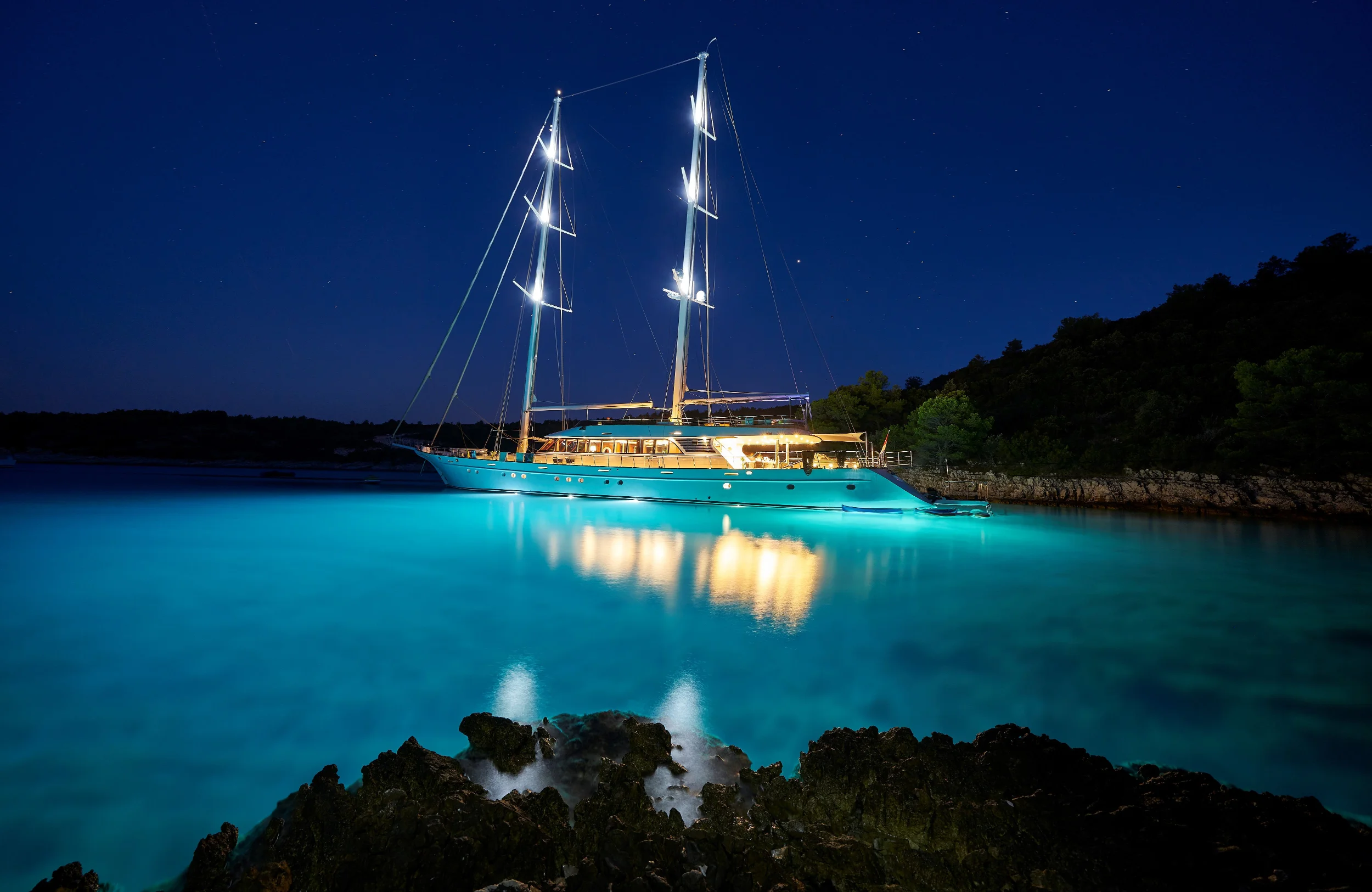

Preveza sits at the mouth of the Amvrakikos Gulf, an hour's sailing from Lefkada and Meganisi. It is the gentlest cruising ground in Greece, and the reason first-time charter guests keep choosing the Ionian over the Aegean.
Most people arrive at Greek chartering through the Cyclades, picture the meltemi, and quietly decide sailing looks like hard work. The Ionian is the answer to that. It sits on the other side of the country, the wind is softer and more predictable, the islands are close enough to see from one another, and Preveza is the port that opens it. For a first charter in Greece, or a family week where nobody wants a long crossing, this is the coast to choose.
Why Preveza works as a charter base
Preveza town sits at the mouth of the Amvrakikos Gulf, on the western Greek mainland. The position is the whole point. You clear the channel and you are already in open Ionian water, with Lefkada immediately south and Meganisi a short hop beyond it. There is no long delivery leg out of a crowded city port before the holiday starts.
The town itself earns a night at either end of the week. It is the administrative and commercial centre of the region, so provisioning is straightforward, and the waterfront is a proper Greek working harbour rather than a marina built for visitors. Seafront pedestrian streets, tavernas that fill after nine, and the fish landed that morning.
Getting there is unusually easy for a Greek charter base. The airport at Aktion sits directly across the channel from the town, a short transfer rather than a domestic connection and a ferry. Our guide to reaching a charter from Scandinavia compares the bases on exactly this.
Where a week from Preveza takes you
The Ionian rewards short days. Distances between anchorages are measured in one or two hours rather than half a day, which changes the character of the week. You swim in the morning, move at lunchtime, and are tied up or anchored by mid-afternoon.
Lefkada and Sivota. The first stop for most boats. Sivota is a deep, almost enclosed inlet on the south coast of Lefkada, ringed with tavernas that run lines out to the quay. It is sheltered in almost any conditions.
Meganisi. Roughly an hour on from Lefkada and the island most guests remember. Spartochori, Vathi and Port Atheni all give you somewhere to tuck in, and the bays along the north shore are quiet enough to swim off the back of the boat before anyone else arrives.
Ithaca. Further south, and worth the extra hour. Kioni and Frikes on the east coast are small, steep-sided harbours with a handful of tavernas each. This is where a week stops feeling like a tour and starts feeling like a place.
Kefalonia. The largest of the group and the usual turning point for a seven-day loop. Fiskardo at the northern tip is the polished end of the Ionian, busier and more expensive, and a good final night before the run back north.
A week comfortably covers Lefkada, Meganisi and Ithaca with time to stop where you like. Ten days lets you add Kefalonia without watching the clock. Your captain will set the actual order around the wind, which in the Ionian usually means going south early and working back north.
The wind, and why it suits beginners
The prevailing summer wind here is the maistro, a north-westerly that fills in through the afternoon and typically blows 10 to 20 knots. It is remarkably regular. Mornings are usually calm, the breeze builds around midday, and it drops again in the evening. That predictability is why the Ionian is the ground we point guests towards when somebody in the group is worried about seasickness.
That rhythm is why the Ionian has the reputation it does. You get real sailing every afternoon without the sustained heavy weather that defines an Aegean summer, and the wind is strongest in the channels between islands where you can see exactly what is coming. For guests who want to take a turn at the helm, this is a forgiving place to do it.
Corfu and the northern Ionian
Preveza opens the southern Ionian. The north of the same sea belongs to Corfu, and it sails differently. Corfu Town is Venetian rather than Greek in its bones, a UNESCO-listed old town of narrow alleys and arcaded streets, with the island's charter berths at Gouvia Marina in a sheltered bay just north of it. The signature run goes south to Paxos and its small neighbour Antipaxos, a half day away, where the best coves can only be reached by boat. The mainland shore opposite, around Parga and Syvota, fills out a week without any long crossing.
We currently list two motor yachts at Corfu: the Azimut 85 Flybridge LA FENICE, 26.8 m with room for 10 guests in 5 cabins, and the Greenline Oceanclass 68 SIR HENDRIK, a 20.8 m yacht built in 2021 that takes 6 guests in 3 cabins with 2 crew. A motor yacht suits this half of the sea. Distances between the northern stops run a little longer than in the Lefkada channel, and covering them quickly leaves more of the day at anchor. Both are on the Corfu destination page.
Which base to choose comes down to the week you want. Preveza points you at the island chain this guide describes, on a catamaran, in the calmest water in Greece. Corfu points you north, at Paxos and the mainland coast, on a motor yacht. With two weeks you can run the whole sea and cross between the halves off Preveza itself.
When to go
The season runs May to October. Late May and June bring warm days, settled water and far fewer boats, and the landscape is still green rather than burnt off. September is the other strong month, with the sea at its warmest and the summer crowds gone. July and August are hot and busy, and the popular harbours fill by mid-afternoon, so a crewed boat earns its keep by getting you in early or anchoring off instead.
If your dates are fixed to the school holidays, book well ahead. Good crews on this coast are committed months in advance, and our guide to when to book a Mediterranean charter sets out the lead times that actually apply.
The boat
The yacht we currently have based in Preveza is the Lagoon 50 ONEIDA 2, a 15.26 m catamaran taking up to 8 guests in 4 cabins, with 3 crew aboard. A catamaran is a sensible match for this cruising ground: the shallow draft lets you anchor closer in than a monohull can, the deck space matters when the boat is your living room for a week, and there is no heel to negotiate at lunch.
The listing shows the current rate and what it covers. If you would rather compare it against other Greek boats, browse the crewed fleet or open the Preveza destination page. The larger Greek fleet sits at Athens on the other side of the country, and the Athens charter guide covers the Saronic and Cyclades alternative to the Ionian.
Every yacht we list is crewed or skippered, so no licence or sailing background is needed from anyone in your group. Our guide to crewed versus bareboat versus skippered explains how the formats differ, and what's included in a crewed charter covers what the rate actually pays for.
Planning your week
If this is your first charter, how to charter a yacht walks through the whole process in order, from choosing a region to sending the request. When you are ready, send an enquiry with your dates and party size and we will put a shortlist together.
Once the charter is confirmed, the yacht charter checklist covers what to bring, which on a catamaran matters mainly because soft bags stow and hard cases do not.